
This year, I almost didn’t get a tree.
Usually, we go as a family to Pineview Farm in New Windsor, which is only open one weekend a year. They hand each group a saw and a cart and say, “Go get the best tree.” They plant concolor firs with silky needles that smell faintly of oranges—I love them. We hike down woodland paths that open into fields with sweeping views, looking for the perfect tree. It doesn’t matter if you choose a four-footer or an eight-footer—same price. The kids bicker about which one is best, then work together to saw it down.
This year, Enrique took William on a birthday trip, so they were out of town that weekend. When they returned, they announced they didn’t want a tree. Too much work, they said.
I celebrated. I had already filled the house with amaryllis and paperwhite bulbs, bought cheery poinsettias, and decorated the pale green pine in our front yard—the one that has finally grown to a respectable height—with silver and pink ornaments and lights. A small Buddha statue sits beneath it, softly lit at night.
Then my daughter, a senior in high school who will be leaving for college next year, quietly asked if we could still get a tree. She was sad.
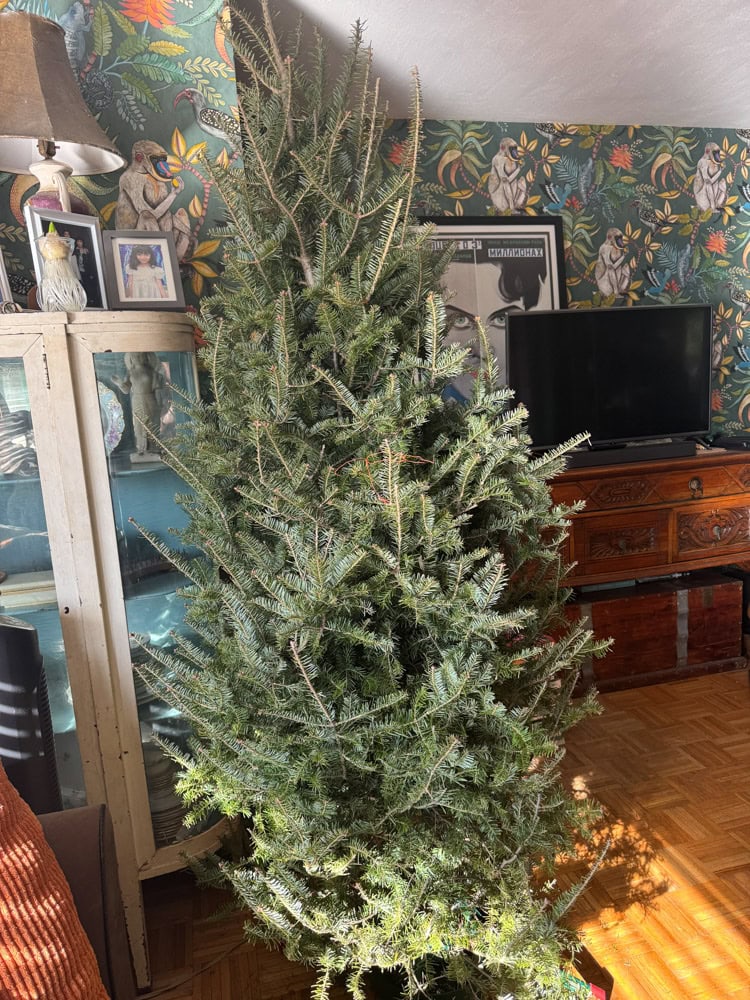
So yesterday, I bought one of the last trees on the lot—thin, tall, and perfect.
What I didn’t fully appreciate at the time is that these winter traditions—bringing greenery inside, adding moisture to the air, lighting up dark spaces—mirror exactly what a whole home steam humidifier does for indoor air quality during the driest months of the year.
Today is the winter solstice, the darkest day of the year. Across cultures, this moment has always been marked with light. Christmas, Hanukkah, and other festivals of light overlap with much older traditions centered on rebirth, greenery, fire, and warmth. Long before modern HVAC systems existed, people instinctively altered their indoor environments to survive winter.
Fresh greenery played a practical role. Christmas trees don’t just look beautiful—they actively release moisture into the air. Every time you refill the tree stand, the tree absorbs water and slowly transpires it back into your home, along with aromatic compounds from pine sap and needles.
Those aromas matter. In Japan, people traditionally take yuzu baths on the winter solstice to ward off illness. In my hometown, the local pharmacy soda fountain served turpentine soda—pine-derived and believed to help when sickness loomed. It sounds strange now, but botanical remedies have always been tied to respiratory health. Turpentine comes from pine resin. Pine compounds still appear in products like Vicks VapoRub. Even spruce beer has centuries-old roots as a winter tonic.
These traditions weren’t superstition. They were environmental adaptations.

Modern homes face a different challenge.
Cold winter air holds very little moisture. When we heat that air and bring it indoors, relative humidity drops even further. Without intervention, many homes fall below 30% humidity in winter—far outside the healthy range.
When indoor air stays too dry, your body feels it quickly. Mucous membranes dry out, making it easier for viruses to penetrate. People notice nosebleeds, cracked hands, static shocks, worsening eczema, and even more frequent colds. Wood floors shrink. Furniture dries and cracks. Plants struggle.
The ideal indoor humidity range is 40–60%. Maintaining that level supports immune function and overall comfort and plays a role in respiratory health, especially during flu and RSV season. We see this connection often in winter illness patterns, which I’ve written about here:
https://shelter-air.com/flu-and-rsv-prevention-tips/08/12/2023/
A whole home steam humidifier addresses this problem by restoring moisture evenly throughout the house, rather than attempting to fix dryness one room at a time.

Once people recognize dry air as the issue, they often start with a small humidifier. Not all humidifiers work the same way, and some introduce new problems if used incorrectly.
Most portable units are ultrasonic or cool-mist humidifiers. Ultrasonic models vibrate water into tiny droplets, releasing them into the air. Whatever minerals or contaminants exist in the water can become airborne as well—often leaving white dust behind. These units also require frequent cleaning to prevent mold growth.
They can help in a single bedroom, but they rarely provide consistent or healthy humidity throughout an entire home.
Bypass and fan-powered humidifiers attach to forced-air systems and rely on airflow across a wet pad. While better than tabletop units, they depend on furnace runtime. On milder winter days, they often underperform. They also waste water and require regular pad replacement.
A whole home steam humidifier heats water until it becomes true steam and introduces that vapor directly into your ductwork. Because the moisture is already vaporized, it distributes evenly and doesn’t rely on constant furnace operation.
Steam also neutralizes bacteria before the moisture enters your air. These systems are controlled by a humidistat and adjust automatically based on outdoor temperatures, preventing over-humidification.
Once installed, they require minimal daily attention—no refilling, no hidden mold reservoirs, no guesswork.

Proper humidity supports everything else we do for indoor air quality. It works alongside filtration, ventilation, and source control. Dry air amplifies problems; balanced air supports health.
I’ve written more about the interconnected nature of indoor air quality here:
https://shelter-air.com/ensuring-healthy-home-air-quality/03/14/2024/
Climate change has also extended the duration and intensity of dry indoor air events in our region, making humidity control more important than it was even a decade ago:
https://shelter-air.com/impacts-climate-change-prolonged-air-quality-events/02/29/2024/
Homes in Westchester County and the Hudson Valley face unique winter challenges. Many houses are older, with a mix of original construction and newer air-sealing improvements. When insulation and air sealing improve without addressing humidity, dryness often worsens.
A whole home steam humidifier is especially effective in this region because it adapts to changing outdoor conditions and works well in both historic homes and high-performance retrofits. Whether you live in a pre-war house in Mount Kisco, a mid-century home in Croton-on-Hudson, or a newer build farther north in the Hudson Valley, humidity must be managed intentionally.
This is not a one-size-fits-all solution. We always evaluate insulation, air leakage, ventilation, and heating systems before recommending humidification. Done correctly, it improves comfort, protects your home, and supports winter health.
I love my Christmas tree. But installing a whole home steam humidifier is far easier—and you don’t have to vacuum needles.
If your family is dealing with nosebleeds, dry skin, static shocks, or constant winter colds, it may be time to look beyond portable fixes.
If you’re in Westchester or the Hudson Valley and want to talk about whether a whole home steam humidifier makes sense for your house, reply to this post or give us a call at (914) 928-2313.
And one last question—what traditions did you let go of this year, and which ones did you hold onto?