

Last night the wind was howling.
Around here in the Hudson Valley, windstorms often bring power outages, voltage swings, and electrical instability. That’s why modern HVAC systems—especially mini-splits and inverter heat pumps—benefit from protection like a mini split surge protector that guards equipment against power spikes and brownouts.
It was the kind of wind that rattles branches and pushes against the house. Around here in the Hudson Valley, when the wind blows hard enough, you start to wonder when the power will go out.
And often, it does.
The sound of the wind unlocked a memory I hadn’t thought about in years.
We lived on top of a mountain in Western Maryland, right where West Virginia and Pennsylvania collide. I was about five years old, trying to walk across a clearing while the wind kept pushing me sideways. I struggled forward for a while and finally gave up.
Instead, I turned around, spread my arms wide, and leaned back into it.
The wind was so strong it pushed against my little body.
And then something magical happened.
The wind caught me and held me upright.
For a moment I wasn’t standing anymore. The air itself was holding me up. It felt like flying without leaving the ground.
It was an incredible feeling.
I’ve tried to recreate it in my mind many times over the years, although I’m not eager to experience winds strong enough to lift my adult body off balance.
But the wind that feels magical as a child reminds us of something else as adults.Where we live, storms also mean power instability.
Windstorms and Electrical Instability
Last night the power went out.
Before that, there was a brownout, when voltage drops below normal levels.
Below is what my home monitor recorded over the past few days.

This log from a home electrical monitor shows a brownout, followed by a community power outage, and finally power restoration.
These voltage swings are common during windstorms in the Hudson Valley — and they can damage modern HVAC systems like mini-splits and inverter heat pumps.
That’s why we install voltage monitoring surge protection with every system we put in.
It protects equipment from power spikes and brownouts before damage occurs.
You can see exactly what happened:
• A brownout Monday evening
• A community power outage just after midnight
• Power restored around 4 AM
Most people think electrical problems only happen during a power outage.
But the truth is that the most damaging events often happen during voltage swings before or after an outage.
These swings can send unstable electrical current through your home’s systems.
And those fluctuations are especially hard on modern HVAC equipment.
Why Modern HVAC Equipment Is More Sensitive
Older heating and cooling systems were relatively simple machines.
Modern systems are very different.
High-efficiency equipment — especially mini-splits and inverter-driven heat pumps — rely on electronic control boards and variable-speed compressors to operate efficiently.
These systems are incredibly precise and efficient, but they are also more sensitive to unstable electrical power.
Voltage spikes, brownouts, or sudden surges can damage:
• control boards
• inverter drives
• compressor electronics
When those components fail, repairs can be expensive.
How a Mini Split Surge Protector Protects Your HVAC System
Because of this, every system we install at Shelter Air includes voltage monitoring protection.
These devices continuously monitor the electrical power entering the system and protect equipment in two important ways.
Surge Protection
If a sudden voltage spike occurs — which often happens when power is restored after an outage — the device prevents that surge from damaging the system.
Brownout Protection
If voltage drops below safe operating levels, the device automatically shuts the system down until power stabilizes.
This prevents the system from trying to operate under unsafe electrical conditions.
Think of it as a bodyguard for your HVAC system.
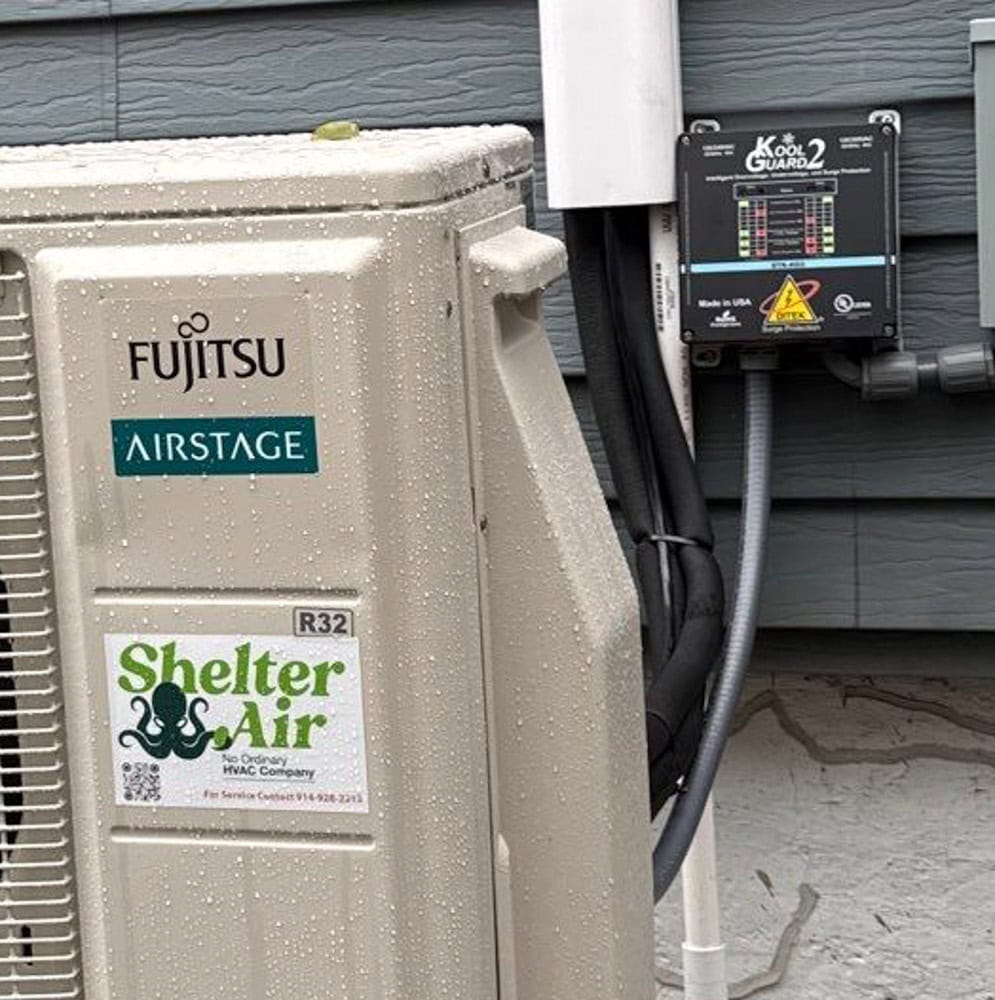
A mini split surge protector is a device installed near the outdoor unit that protects the system from electrical surges and unstable voltage. It monitors incoming power and shuts the equipment down if voltage spikes or drops to unsafe levels, preventing damage to sensitive electronics and inverter compressors.
Modern mini-splits and inverter-driven heat pumps rely on electronic control boards and variable-speed compressors. These components are more sensitive to electrical instability than older HVAC systems. Voltage spikes and brownouts during storms or power outages can damage these parts, leading to expensive repairs.
Yes. A surge protector or voltage monitoring device can usually be installed on an existing mini-split or heat pump system. The device is mounted near the outdoor unit and connected to the electrical supply to monitor voltage and protect the equipment from surges and brownouts.
The voltage monitor sits quietly beside the outdoor unit, constantly watching incoming power and protecting the equipment from electrical instability.
A Small Upgrade That Prevents Expensive Failures
If you already have a mini-split or inverter heat pump, and it wasn’t installed with voltage monitoring protection, it can usually be added afterward.
It’s one of the smallest upgrades we offer — and one of the most effective ways to prevent expensive equipment failures.
As weather events become more frequent and electrical grids experience increasing strain, protecting sensitive equipment is simply good engineering.
A Quiet House During a Storm
After the power went out last night, something else struck me.
The house stayed warm.
Good insulation and proper air sealing will do that. I lay there in the quiet — no machines, no fans or motors, no lights — just the sound of the wind outside doing its thing.
Maybe that’s why I like camping so much.
There’s something settling about being still inside while the world moves outside.
But I also like knowing that when the power comes back on, my equipment is protected.
The same wind that held up a five-year-old on a mountain in Maryland was rattling transformers and swinging voltage all night long.
Wind can be magical.
What it does to your electrical system usually isn’t.
Protecting Your HVAC System
If you’d like to talk about adding voltage monitoring protection to your HVAC system, reach out.
It’s one of the smallest investments we offer — and one of the most important when it comes to protecting modern heating and cooling equipment.
Local Voltage Protection for Mini-Splits and Heat Pumps
At Shelter Air, we install voltage monitoring protection on many of the mini-split and heat pump systems we service throughout Beacon, Fishkill, Newburgh, Wappingers Falls, and the Hudson Valley. If your system was installed without surge and brownout protection, it can usually be added quickly to help protect sensitive inverter equipment from electrical instability.
If you’re unsure whether your system is protected, feel free to reach out. We’re always happy to take a look.
—
Kimberly Sevilla
Founder, Shelter Air
Beacon, New York
Estimated reading time: 7 minutes