
Dry winter air is one of the biggest reasons homeowners in the Hudson Valley and Westchester County turn to humidifiers to stay comfortable and healthy indoors.
This Year, I almost didn’t get a tree.
Usually, we go as a family to Pineview Farm in New Windsor that’s only open one weekend a year. They hand each group a saw and a cart and say, “Go get the best tree.” They plant Concolor Firs with silky needles that smell like oranges—I love them. We hike down woodland paths that open to fields with stunning views to find the perfect tree. It doesn’t matter if you pick a four-footer or an eight-footer—same price. The kids bicker about which is the best tree and which one to select and work together to eventually saw it down.
This year, Enrique took William on a birthday trip, so they were out of town that weekend. When they returned, they announced they didn’t want a tree. Too much work, they said.
I celebrated. “That’s okay,” I told them. I’d already filled the house with amaryllis and paperwhite bulbs, bought some cheery poinsettias, and eventually decorated the pale green pine on our front lawn—the one that’s finally grown to a respectable height—with silver and pink balls and lights. It’s pretty. A little Buddha statue sits below with a spotlight at night.
Then my daughter, a senior in high school who’ll be leaving for college next year, quietly asked if we could get a tree. She was sad.
So yesterday, I got one of the last trees on the lot—thin, tall, and perfect.
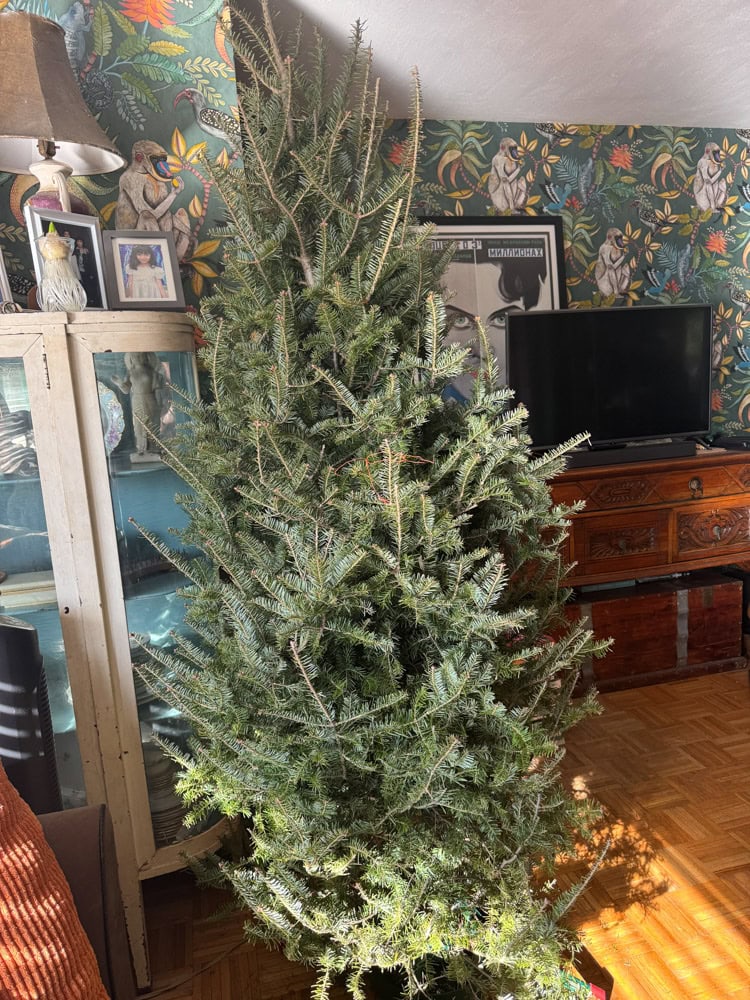
It’s funny, these traditions of lighting up the world. Today is the winter solstice, and the Festival of Lights coincides with this darkest day. Christmas, Hanukkah, and so many other holidays were backed into much older traditions that included gifts and bringing in fresh greenery from outside. The child god was an Egyptian symbol of solstice rebirth. Around the world, the day was celebrated with fires, feasts, and lights.
An interesting thing I’ve noticed: Christmas trees also add much-needed humidity to the air—every time you refill the stand, the tree is drinking and transpiring moisture along with beneficial aromatic molecules. I’m sure the aerosols produced by the trees help stave off illness. The Japanese traditionally took yuzu baths on the winter solstice—the aroma fights off illness. There was a pharmacy in my hometown with an old-fashioned soda fountain that served turpentine soda at the counter. The locals swore by this remedy.
It was one of those old stores with creaking floors and a grand, ornate soda fountain with stools that spun, an etched mirror, and shiny chrome soda syrup dispensers. The drink was what people had when they felt an illness coming on. It was a college town, and having a turpentine or ammonia soda was a rite of passage. By today’s standards it sounds strange, but at the time it was just another botanical remedy. Ammonia sodas were hangover cures. Remember, the original Coca-Cola and sarsaparilla were also remedies—botanical concoctions sold at pharmacy counters to cure what ailed you. People distill turpentine from pine sap, just another plant extract in a long tradition of aromatic medicines. It’s even an ingredient in Vicks VapoRub—we’re still using pine-derived compounds to fight respiratory illness. My sister and I used to chew on spruce needles as kids—spruce beer has been brewed for centuries for its health benefits.

Once people realize their air is too dry, the next instinct is often to buy a small humidifier and plug it in next to the bed. And while that can help a little, not all humidifiers work the same way—and some can actually create new problems if they’re not chosen or maintained carefully.
Portable (Tabletop) Humidifiers
These are the ones most people are familiar with: small units you fill with water and place in a bedroom or living room. They typically fall into two categories—cool mist or ultrasonic.
Ultrasonic humidifiers use a vibrating disc to break water into tiny droplets and release them into the air as a mist. They’re quiet and inexpensive, but there’s a catch: whatever is in the water—minerals, bacteria, mold—can also become airborne if the unit isn’t cleaned constantly or if distilled water isn’t used. That white dust you sometimes see on furniture? That’s mineral residue.
Cool mist evaporative units use a fan to blow air across a wet wick or filter. They’re a bit safer from a hygiene standpoint, but they still require frequent cleaning and filter changes. And because they only affect one room at a time, they’re rarely enough to properly humidify an entire house.
In other words: they’re fine for short-term relief, but they’re high-maintenance and limited in scope.
Bypass and Fan-Powered Whole-Home Humidifiers
These are often installed directly onto a forced-air heating system. They work by passing warm air over a wet pad while the furnace runs, allowing moisture to evaporate into the air stream.
They’re a step up from portable units, but they have limitations. Because they rely on airflow from the heating system, humidity delivery can be inconsistent. On milder winter days—when your furnace isn’t running much—they don’t do very much at all. They also require regular pad replacement and can waste a fair amount of water.
For some homes, they’re a reasonable middle ground. For others, they’re underwhelming.
Steam Humidifiers (My Preferred Option)
Steam humidifiers are different. They heat water until it becomes true steam—just like a kettle—and then inject that steam directly into your ductwork. Because the moisture is already vapor, it distributes evenly throughout the home and doesn’t depend on constant furnace runtime.
This is why steam humidifiers are my favorite, especially in older homes, high-performance retrofits, or houses with sensitive occupants. They’re precise, controlled by a humidistat, and capable of maintaining that ideal 40–60% relative humidity range without overdoing it.
They’re also far more hygienic. Steam kills bacteria and mold before the moisture ever enters your air, so you’re not aerosolizing whatever happens to be in your water supply. Once installed, they’re largely automatic—no daily refilling, no moldy tanks hiding under the bed.
Set it. Forget it. Breathe easier.

A Word of Caution
Humidity is powerful. Too little dries you out—but too much can cause condensation, window rot, and even mold growth inside walls if a home isn’t properly evaluated.
That’s why whole-home humidification should never be a one-size-fits-all solution. We look at insulation levels, air sealing, ventilation, and how your home actually behaves in winter before recommending anything. Done correctly, humidification supports your immune system, protects wood floors and furniture, and makes your home feel warmer at lower thermostat settings. Done incorrectly, it can cause damage.

I’m enjoying my Christmas tree, but installing a whole-home humidifier in your Westchester County Home is much easier—and you don’t have to vacuum up needles. If your family is dealing with nosebleeds, dry skin, or constant colds this winter, let’s talk about adding a steam humidifier to your home. Reply to this email or give us a call at (914) 928-2313.
On another note, what traditions did you want to skip this year? What folk traditions does your family swear by?
PS Happy Holidays!