
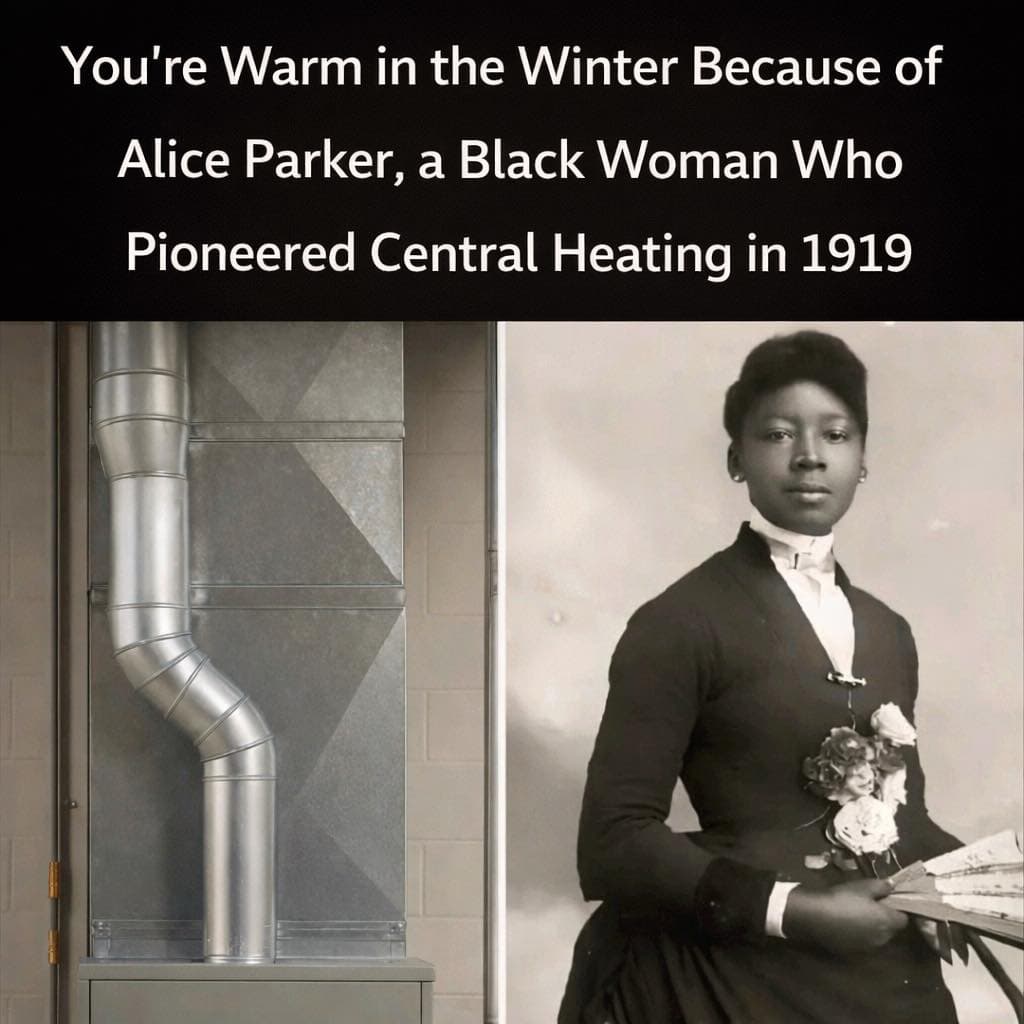
Before History Remembered Her Name
An African American Woman Designing Comfort—Before History Remembered Her Name
Alice H. Parker was an African American woman inventing in the early 20th century—at a time when women were rarely recognized for technical work and Black inventors were routinely erased from history. Her name doesn’t show up in most HVAC textbooks, yet her ideas helped shape how homes are heated to this day.
During Black History Month, it’s worth pausing to recognize contributions like Parker’s—not as trivia, but as foundational work that quietly changed everyday life.
A Note on Her Image
For years, a photograph has circulated online, claimed to be Alice H. Parker—but it’s actually of a different Alice Parker, a white woman. Someone recently pointed this out to me, and I’ve corrected it on our website. Even the imagery around her story has been misattributed, which says something about how easily Black inventors get written out of history.
Women Have Always Been in Charge of Comfort
Long before thermostats and ductwork, women were responsible for the comfort and health of the home. They maintained fires, managed fuel, opened windows to air out rooms, and made daily decisions about warmth, airflow, and cleanliness.
Comfort wasn’t abstract. It was practical. It was survival.
Too much smoke meant illness. Poor airflow meant stale air. Uneven heat made a house hard to live in. These were problems solved through observation, repetition, and lived experience—what we’d now call building science.
Alice H. Parker and Practical Problem-Solving
Alice Parker didn’t invent in a vacuum. When she connected the dots between gas fires and a centralized heating system, she was likely thinking about efficiency, safety, and consistency—how to heat a home without constant tending, open flames, or uneven warmth.
In 1919, she patented a design for a gas-powered central heating system that distributed warm air through ducts to multiple rooms. That idea—central heat with distribution—is still the backbone of modern HVAC design.
This wasn’t about luxury. It was about making homes work better.
Comfort Has Always Been Systems Thinking
What Parker proposed mirrors how we approach good HVAC today. Comfort isn’t about one appliance or one room. It’s about how heat moves, how air circulates, and how a building supports the people inside it.
That kind of thinking didn’t originate in labs alone—it came from homes, from lived experience, and from people who understood comfort as a whole-system problem.
Why Her Story Matters Now
At Shelter Air, we spend our days dealing with the consequences of poor system design—uneven heat, bad airflow, shortcuts that ignore how homes are actually lived in.
Alice H. Parker’s work reminds us that good design starts with empathy and observation. She saw a problem others accepted as “just how it is” and imagined something better. She received a patent for her contribution in 1919, yet her name largely disappeared from the story of how modern heating systems evolved.
Her legacy lives on every time central heat quietly does its job.
And it’s long overdue that her name does too.