A Different Kind of Easter
Why Allergies Are Worse Inside Your Home (Spring in the Hudson Valley)
Spring in the Hudson Valley always brings two things with it—traditions like pickled beet eggs, and a noticeable shift in indoor air quality and the question of why allergies seem worse inside your home.
My kids are at that in-between age now—the Easter Bunny doesn’t really come anymore, but somehow… they still want him to.
It has me thinking of my childhood Easters.
When Easter Was a Full Production
Growing up, Easter was a full production.
We’d go to my grandmother’s house and stay overnight—cousins everywhere, sleeping bags covering the floors. In the morning, we’d wake up to our Easter baskets. All the aunts would pool the candy together, and it felt like a quiet competition to see who could bring the most.
There was always too much. The baskets overflowed.
We weren’t allowed to eat any candy before Mass. I’d sneak a piece anyway, tuck it into my pocket, and eat it the second we got out—right there on the church steps.
There were rules. Something about needing to receive communion on an empty stomach. I didn’t fully understand it, but I followed it… mostly.
After Church, Everything Opened Up
The highlight was the Easter egg hunt.
There were three kinds of eggs:
- Hard-boiled
- Candy-filled
- Eggs with money inside
I liked to stir things up—I’d sneak a couple of raw eggs into the pile of decorated ones. We’d crack them on our foreheads, and inevitably, someone ended up with egg running down their face.
The little kids wanted candy.
The older kids wanted money.
I wanted the hard-boiled eggs. Too much candy made my stomach hurt.
My cousin John figured out early that a Reese’s Peanut Butter Cup could be flipped for three times its value. He’d sell candy to the little kids when they found money.
My parents thought it was borderline criminal.
I thought it was brilliant.
He did well in life.
What Was Always on the Table
We’d sit down to a potluck that never really changed:
Ham
Ambrosia salad
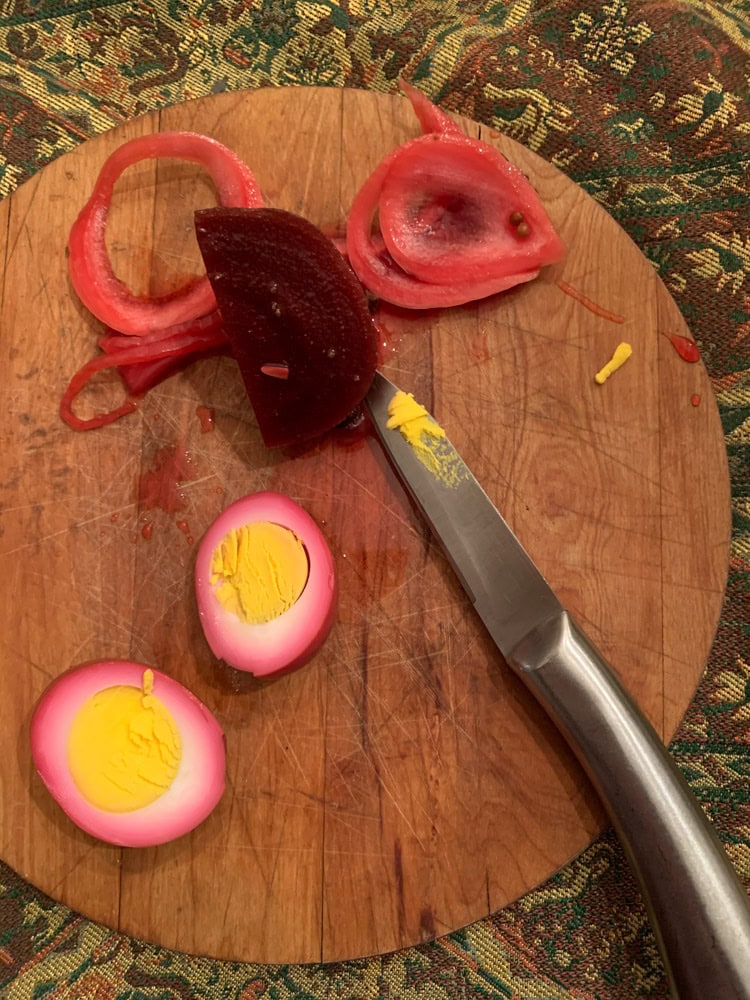
Pickled beet eggs
And always, the lamb cake
My aunt Pat made the lamb-shaped cake every year—usually red velvet, covered in coconut, so when you cut into it, it looked… a little shocking. It was a running joke.
And the beet eggs were always there. Deep magenta, tucked between everything else. Sharp, a little sweet, and unmistakable.
If you grew up with them, you know.
The Beet Eggs I Still Make
I still make them the same way—maybe a little better now that I use fresh ingredients.
18 hard-boiled eggs, peeled
2 packs cooked beets (or fresh), sliced
1 large onion, thinly sliced
2 cups apple cider vinegar
1 cup water
½ cup brown sugar
1–2 tablespoons pickling spice
1 teaspoon salt
1–2 bay leaves
Bring the vinegar, water, sugar, spice, and salt to a boil and let it simmer for a few minutes.
Layer the eggs, beets, and onions in a half-gallon jar and pour the hot brine over everything. Into the fridge it goes.
Give it a week if you can. Two is better. The color works its way all the way through, and everything settles into itself.
They make incredible deviled eggs.
(I made a video back in 2020—I’ll link it if you want to see it step by step.)
The Photos That Stay With You
There are photos from those days—the girls lined up on the porch in our new Easter outfits.
One year, my little cousin refused to get dressed. She’s standing there in her Carter’s underwear, stubborn as anything.
It’s one of my favorite pictures.
Things felt simpler then.
You got dressed up. You went to church. You went to your grandmother’s.
That was Easter.
Indoor Air Quality Questions I Hear Every Spring
Easter has always marked the shift into spring for me.
And spring, whether we like it or not, means something else too—pollen.
You can see it starting now. The trees swelling, that first haze in the air. My yard has been blooming for weeks—daffodils, tulips, irises.
It’s beautiful—but it’s also when indoor air quality shifts, and allergies often feel worse inside your home.
It’s the start of allergy season, when indoor air quality in Hudson Valley homes begins to change in a noticeable way.
Indoor Air Quality Questions I Hear in Hudson Valley Homes
This time of year, I hear the same things over and over:
Why does my house feel stuffy?
Why are my allergies worse inside than outside?
Why isn’t my system keeping up?
It’s not just your imagination.
Your home changes with the season, just like everything else.
Most of these questions come down to why allergies are worse inside your home.
What’s in the Air
When I think about Easter now, I don’t just think about candy and egg hunts.
I think about what’s in the air and why allergies are worse inside the home.
Spring is when everything wakes up—trees, flowers, soil… and all the particles that come with it. Pollen, dust, moisture. The things you can see, and a lot that you can’t.
You can see it starting now—the trees swelling, that first haze in the air.
If you want to track it, you can check local pollen levels in the Hudson Valley.
Most homes aren’t set up to deal with that.
We focus so much on heating and cooling, but air quality is its own system. It’s not one product—it’s a suite of things working together.
Depending on the house, that might include:
- Media filters to capture fine particles
- UV lights to keep coils and air handlers clean
- Ionizers to reduce airborne contaminants and odors
- ERVs (Energy Recovery Ventilators) to bring in fresh, fitered air without losing efficiency
- Dehumidifiers to control moisture before it becomes a problem
And then there’s monitoring.
We install the HAVEN IAQ system, which continuously tracks what’s happening inside your home—humidity, CO₂, particle levels, even radon.
What I like about it is that it doesn’t just sit there and collect data. It actually responds. If something drifts out of range, it can activate different parts of the system to bring things back into balance.
Because most people don’t realize there’s a problem until they feel it—stuffy air, headaches, allergies that won’t go away sometimes feeling worse inside than outside.
Most people don’t think about indoor air quality until they feel it.
By then, it’s already been building.
Air Sealing, Infiltration, and What You’re Bringing Inside
Air sealing and infiltration are where building science really starts to matter. Most homes are constantly pulling in outside air—and everything in it.
Where air (and pollutants) get in:
- Attic bypasses
- Rim joists
- Leaky ductwork
- Gaps around windows and doors
What comes with it:
- Pollen
- Dust
- Moisture
These aren’t just outside—they’re being drawn into your living space.
How we approach it:
- Look at how air moves through the home
- Identify where it’s entering
- Control it through:
- Air sealing (tightening the envelope)
- Duct sealing
- Proper ventilation
That combination is what actually improves indoor air quality—not just heating and cooling alone.
Simple habits that make a real difference:
- Take your shoes off at the door
- Change clothes after being outside
- Vacuum regularly (especially during allergy season)
It all works together.
The Way Your Home Should Feel
A home should feel like relief.
Not something you notice because it’s uncomfortable—but something you don’t think about at all because it just feels right.
That’s what we’re working toward with every system we design.
Not just heating and cooling.
The whole environment.
A Small Thing That Makes a Big Difference
If you haven’t scheduled your spring tune-up yet, now’s the time.
It’s a small thing that makes a big difference—keeping your system clean, your air moving properly, and your home feeling the way it should.
And if you’ve been dealing with allergies, this is the season where indoor air quality really matters.
Once you understand why allergies are worse inside your home, the fixes start to make sense.
What About You?
I’d love to hear from you—
What were your Easter traditions growing up?
Did you have the lamb cake? The egg hunts? The rules about candy?
Some things change.
Some things stay with you.
Indoor air quality in the Hudson Valley isn’t something most people think about—until they feel it.
— Kimberly
Shelter Air
No Ordinary HVAC Company