
I recently had an experience that reminded me—again—why proper duct insulation is not optional, even when ductwork runs through “conditioned” space and even when skipping it makes a bid look cheaper.
The Low-Bid Reality Check
I was working on a project quote when another contractor came in lower. When the homeowner asked me why, we dug into the details.
The difference?
The other company had excluded insulation on ductwork running through open space above offices.
That’s not a minor omission.
That’s a building-science problem waiting to happen.
The Dew Point Lesson Some Contractors Forget
Not long after that, I watched a YouTube video from someone presenting themselves as an HVAC expert. He dismissed insulating ducts in conditioned spaces as “silly,” arguing that any heat loss during winter would simply help warm the space.
That argument sounds reasonable—until you think about cooling season.
And cooling season is where this logic completely collapses.
Understanding Dew Point: The Science Behind Condensation
Condensation isn’t mysterious. It’s physics.
Dew point is the temperature at which moisture in the air turns into liquid water. The higher the humidity, the higher the dew point—and the easier it is for condensation to form.
Here are some real-world examples:
- At 70°F and 50% relative humidity, the dew point is ~51°F
- At 75°F and 60% RH, the dew point jumps to ~60°F
- At 80°F and 65% RH, the dew point is around 67°F
Now picture a humid summer day.
Your air conditioning is delivering ~55°F supply air through metal ductwork.
If the surrounding space is 75°F at 60% humidity (dew point ~60°F), and the duct surface drops below that temperature, condensation forms.
You’ve seen this before—those dewy mornings when grass and cars are wet even though it didn’t rain. Warm, humid air meets a cooler surface.
Your ductwork is no different.
What Happens When Ducts Aren’t Insulated
When cold air moves through uninsulated ducts during cooling season:
- Moisture condenses on the outside of the duct
- Water drips onto ceilings, walls, furniture, equipment, and artwork
- Over time, you invite staining, corrosion, mold growth, and material damage
This can happen even in conditioned spaces, especially when humidity control isn’t perfect—which is most buildings, most of the time.
The Heating-Season Myth
Yes, during heating season, uninsulated ducts will leak some heat into the surrounding space.
But here’s what that argument ignores:
- You’re already paying to heat that space—why do it inefficiently through duct losses instead of properly designed supply air?
- Those same uninsulated ducts become condensation risks all summer
- You end up with uneven temperatures: rooms near the air handler are over-conditioned, and rooms farther away are under-served
It’s short-sighted thinking that trades year-round performance and durability for a marginal benefit a few months of the year.
The Two Main Reasons We Insulate Ductwork
1. Condensation Control
Even in conditioned spaces, insulation keeps duct surface temperatures above dew point during cooling season—preventing moisture problems before they start.
2. Temperature Integrity
Insulation ensures the air you paid to heat or cool actually arrives at the register at the intended temperature, improving comfort and system performance.
Three Ways to Insulate Ductwork
Fiberglass Duct Wrap (Foil-Faced)
Effective, but unpleasant to work with and easy to install poorly if rushed.
Internally Insulated Duct
Not our preference. Internal liners make future cleaning and inspection difficult and can introduce their own hygiene concerns.
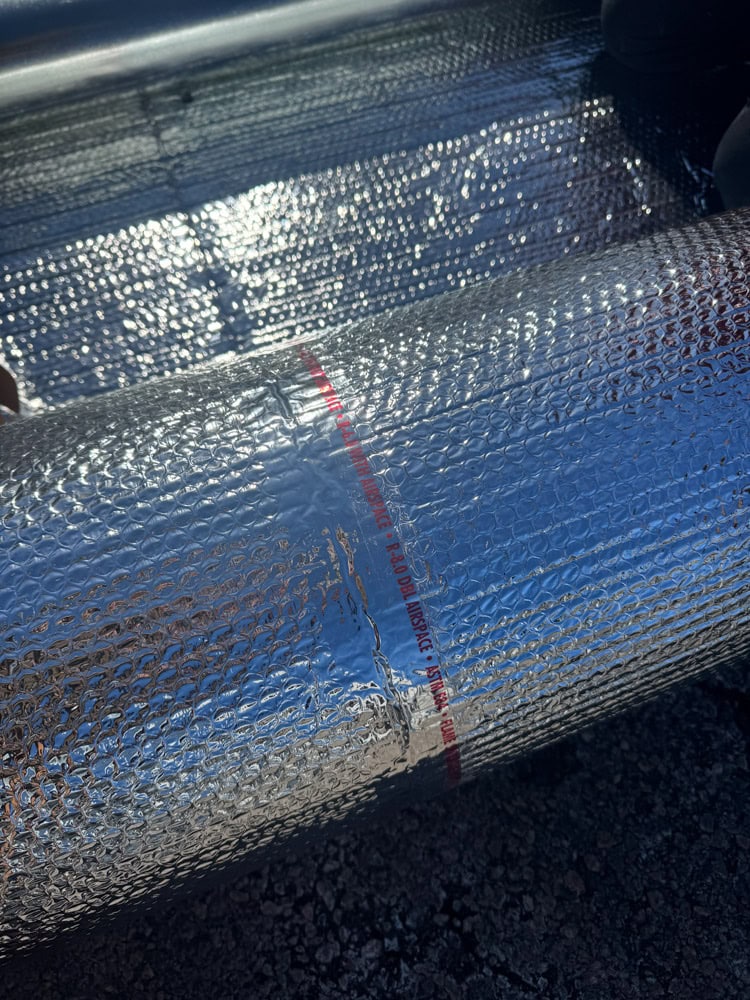
Foil Bubble Insulation (Our Preferred Option)
Yes—bubble wrap. But not the packing kind.
This is foil-faced, HVAC-rated insulation with different R-values depending on installation:
- Single layer: R-4.2
- Single layer with air space: R-6
- Double layer (“double bubble”): R-8
We typically use R-4.2 in conditioned spaces and R-8 in attics or other unconditioned areas, based on the application—not guesswork.
The Bottom Line
When a bid comes in suspiciously low, ask what’s missing.
Skipping duct insulation may save money upfront, but it creates long-term risks—from water damage to energy loss to comfort complaints.
And don’t fall for the “it helps heat the space” argument. That’s trading nine months of potential problems for three months of marginal benefit.
That’s not good design.
That’s cutting corners.
And yes—this is also the story of bubble wrap insulation.Fun fact: it does make a surprisingly dramatic fashion statement. I briefly considered a bubble-wrap shawl. Jury’s still out.